


 Home > Products
How to Choose IR-600 and IR-1000 for Coatings and Plastics
Infrared reflective TiO2 is increasingly used in coatings and plastics where solar heat management is required. Unlike conventional titanium dioxide, which is mainly selected for whiteness, opacity, and hiding power, infrared reflective TiO2 is designed to improve near-infrared reflection and reduce heat absorption under sunlight.
For formulators, the key question is usually not whether infrared reflective TiO2 can help, but which grade should be selected for a specific formulation.
Inter-China Chemical offers two main infrared reflective TiO2 products: IR-600 and IR-1000. Both are developed for solar heat management, but they are positioned for different color systems, substrates, and application requirements.
This guide explains how to choose between IR-600 and IR-1000 for coatings and plastics.
1. The Basic Selection Logic
The simplest way to understand the difference is:
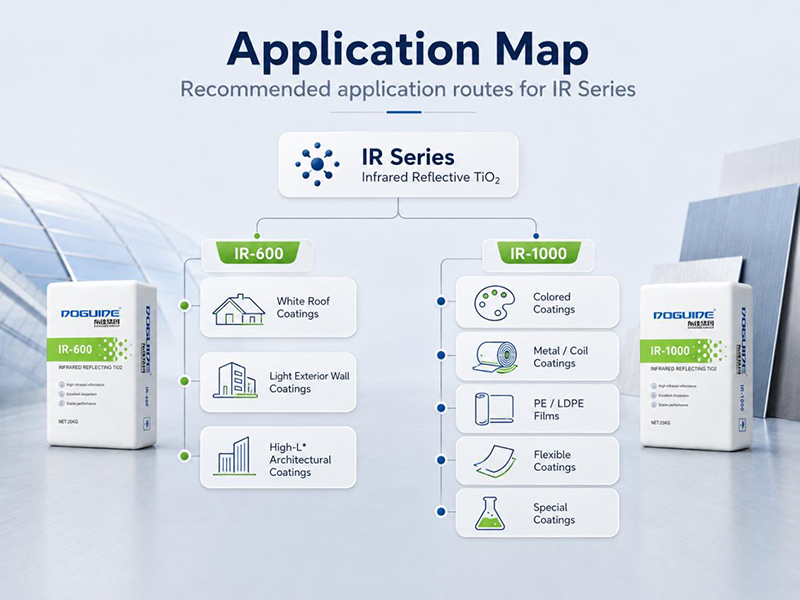
IR-600 is mainly recommended for white, light-colored, and high-brightness systems.
IR-1000 is mainly recommended for colored systems, metal coatings, flexible coatings, plastic films, and special coating applications.
|
Product |
Main Positioning |
Typical Applications |
|
IR-600 |
White, light-colored, and high-brightness systems |
Cool roof coatings, white exterior wall coatings, light-colored architectural coatings |
|
IR-1000 |
Colored and wider-substrate systems |
Colored exterior coatings, metal coatings, coil coatings, automotive coatings, plastic films, flexible coatings, special coatings |
This does not mean IR-600 can only be used in white coatings, or IR-1000 can only be used in colored systems. Final selection still depends on the complete formulation, color design, resin system, processing conditions, and performance targets.
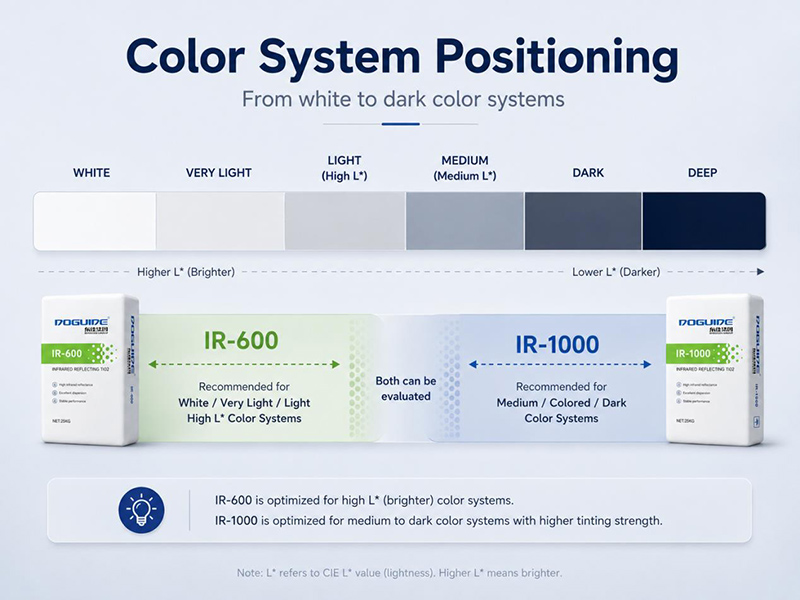
However, as a practical starting point, this positioning helps formulators reduce unnecessary trial-and-error.
2. When to Choose IR-600
IR-600 is designed for coating systems where high brightness and strong solar reflectance are important.
It is especially suitable when the formulation target is:
● White or near-white color
● Light-colored coating
● High L* value
● High total solar reflectance
● Strong near-infrared reflectance
● Exterior heat reduction
● Cool roof or wall coating applications
In white and light-colored systems, visible light reflectance is already high. The key challenge is to further improve solar heat management through near-infrared reflection while maintaining the required appearance.
IR-600 is a suitable choice for this type of formulation because it is positioned around high-brightness and medium-to-high lightness systems.
3. Typical Applications for IR-600
White Cool Roof Coatings
Cool roof coatings require high solar reflectance to reduce heat absorption on roof surfaces. In white systems, IR-600 can be used as a functional TiO2 material to support both color and heat-reflective performance.
Typical formulation concerns include:
● Whiteness
● Hiding power
● Total solar reflectance
● Near-infrared reflectance
● Weather resistance
● Outdoor durability
● Compatibility with acrylic, silicone, or other roof coating systems
Light-Colored Exterior Wall Coatings
For exterior wall coatings, color appearance is important, but heat reduction is also becoming a stronger market requirement, especially in hot climates and urban buildings.
IR-600 is suitable for:
● White exterior wall paint
● Beige or cream-colored wall coatings
● Light gray architectural coatings
● High-brightness decorative coatings
High-L* Architectural Coatings
When the target color has a high L* value, IR-600 is usually the more direct starting product. It helps formulators build a heat-reflective coating system without moving too far away from the expected light appearance.
4. When to Choose IR-1000
IR-1000 is positioned for broader application flexibility, especially where color, substrate, or processing conditions are more complex.
It is typically recommended when the formulation involves:
● Colored coating systems
● Darker or medium-color systems
● Metal coatings
● Coil coatings
● Automotive coatings
● Plastic films
● Flexible coatings
● Multi-substrate applications
● Special coating systems
In colored coatings and plastics, the formulation challenge is different from white coatings. The product must help improve infrared reflection while preserving the intended visible color. That is why IR-1000 is often selected for systems where color design and substrate compatibility are more demanding.
5. Typical Applications for IR-1000
Colored Exterior Wall Coatings
For colored exterior wall coatings, normal pigments may absorb more solar energy, especially in darker shades. IR-1000 is suitable for formulations where the customer wants to maintain color appearance while improving near-infrared reflection.
It can be evaluated in:
● Green exterior coatings
● Gray exterior coatings
● Beige and earth-tone coatings
● Medium-dark architectural colors
● Solar-reflective colored wall coatings
Metal Coatings and Coil Coatings
Metal coatings are not only evaluated by solar reflectance. Industrial coating systems also require process stability and mechanical performance.
For coil coatings and pre-painted metal systems, customers normally need to test:
● Baking stability
● Adhesion
● Flexibility
● T-bend performance
● MEK resistance
● Salt spray resistance
● Weatherability
● Gloss retention
● Post-forming film appearance
IR-1000 is more suitable as the starting grade for these industrial coating systems because it is positioned for colored systems, metal coatings, and broader substrate applications.
Automotive Coatings
Automotive coatings require strict control of color, appearance, gloss, weather resistance, and film durability. IR-1000 can be evaluated in heat-reflective colored automotive coating systems, especially where near-infrared reflection is needed without significantly changing the visible color design.
PE and LDPE Plastic Films
IR-1000 is also recommended for plastic film applications, including PE and LDPE film systems.
In film applications, the formulation target may include:
● Heat insulation
● Lower surface temperature
● Light transmission
● Film transparency or translucency
● Weather resistance
● Compatibility with polymer processing
Compared with conventional TiO2, IR-1000 can be evaluated where the customer wants to balance solar heat management with film optical performance.
Flexible Coatings and Special Coatings
IR-1000 can also be considered for flexible coatings, plastic substrates, membrane coatings, and other special coating systems where formulation flexibility is important.
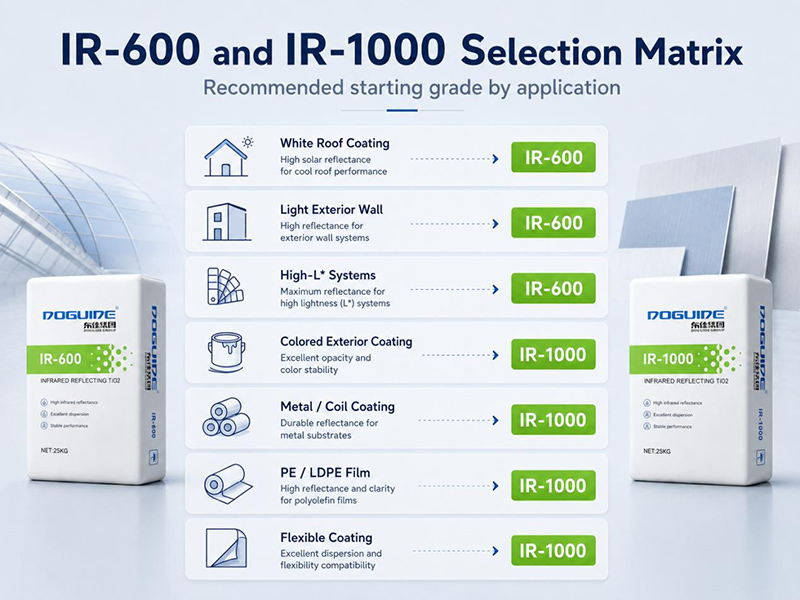
6. IR-600 vs IR-1000 Selection Table
|
Application / Formulation System |
Recommended Starting Grade |
Reason |
|
White cool roof coating |
IR-600 |
Suitable for white and high-brightness systems |
|
Light-colored exterior wall coating |
IR-600 |
Good starting point for medium-to-high lightness colors |
|
High-L* architectural coating |
IR-600 |
Designed for light and bright color systems |
|
Colored exterior wall coating |
IR-1000 |
Better positioned for colored coating systems |
|
Metal coating |
IR-1000 |
Suitable for colored and industrial coating applications |
|
Coil coating |
IR-1000 |
Better fit for metal substrates and process-demanding systems |
|
Automotive coating |
IR-1000 |
Suitable for colored, appearance-sensitive coating systems |
|
PE / LDPE plastic film |
IR-1000 |
Recommended for plastic film heat management |
|
Flexible coating |
IR-1000 |
Suitable for wider-substrate and flexible systems |
|
Special coating systems |
IR-1000 |
More adaptable for non-standard applications |
7. Key Factors Before Final Selection
Although product positioning is useful, final selection should always be confirmed through formulation testing.
Customers should evaluate the following factors before choosing the final grade.
Color and Brightness
For white and light-colored systems, IR-600 is generally the first choice.
For colored systems, IR-1000 is usually more suitable.
Important indicators include:
● L* value
● Color difference
● Tinting strength
● Visible appearance
● Gloss impact
Solar Reflectance Performance
The main purpose of infrared reflective TiO2 is solar heat management. Customers should test:
● Total solar reflectance, TSR
● Near-infrared reflectance, NIR
● Surface temperature reduction
● Heat build-up under simulated sunlight
● Outdoor exposure performance
Resin and Formulation Compatibility
Different coating systems may respond differently to the same TiO2 grade.
Recommended checks include:
● Dispersion performance
● Viscosity impact
● Storage stability
● Film formation
● Compatibility with pigments and fillers
● Compatibility with additives
Processing Conditions
For plastic films and industrial coatings, processing conditions are critical.
Customers should consider:
● Extrusion temperature
● Film thickness
● Addition level
● Baking temperature
● Curing conditions
● Shear and dispersion process
● Substrate type
Final Application Requirements
Heat reflection is only one part of product performance. The final formulation must also meet the full application requirements.
For example, exterior wall coatings need weather resistance and color stability. Coil coatings require flexibility, adhesion, solvent resistance, and post-forming performance. Plastic films may require transparency, tensile properties, and process stability.
8. Practical Recommendation
For most customers, the recommended starting logic is:
Choose IR-600 when the target system is white, light-colored, or high-brightness.
Choose IR-1000 when the target system is colored, metallic, flexible, plastic film-based, or substrate-complex.
If the application is a white roof coating, white wall coating, or light architectural coating, IR-600 should usually be tested first.
If the application is a colored exterior coating, metal coating, coil coating, automotive coating, PE/LDPE film, or flexible coating, IR-1000 is usually the more suitable starting product.
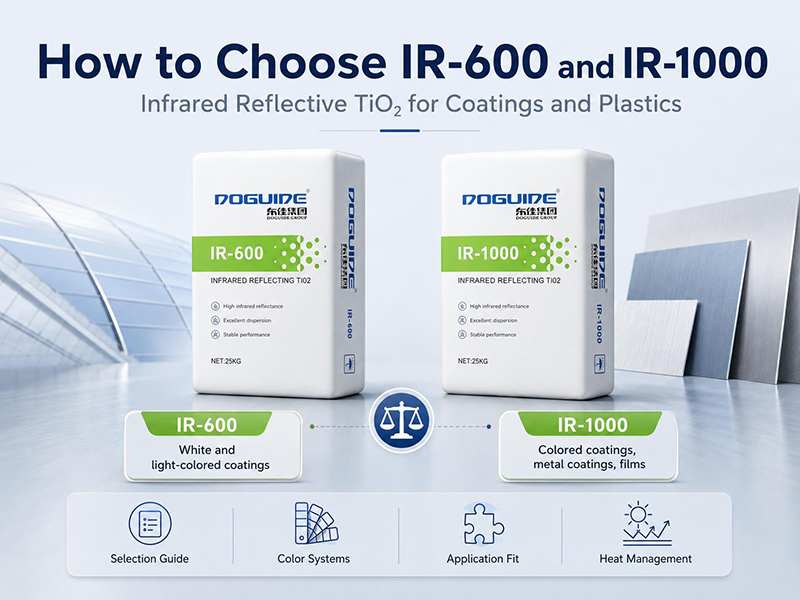
For applications between the two categories, such as medium-light colored architectural coatings, both IR-600 and IR-1000 can be tested side by side to compare reflectance, color appearance, dispersion, and final coating performance.
9. Conclusion
IR-600 and IR-1000 are both infrared reflective TiO2 products for solar heat management, but they are not positioned in the same way.
IR-600 is mainly designed for white, light-colored, and high-brightness coating systems. It is a strong starting choice for cool roof coatings, white exterior wall coatings, and light architectural coatings.
IR-1000 is designed for broader and more complex applications, including colored coatings, metal coatings, coil coatings, automotive coatings, PE/LDPE films, flexible coatings, and special coating systems.
The correct choice depends on color design, substrate, resin system, processing conditions, and final performance requirements. By selecting the right starting grade, formulators can build more efficient solar heat management systems with fewer formulation adjustments.

Building C19 ZNUSP, No. 99 Jingshiwu Road, 212009, Zhenjiang, Jiangsu, China

+86-511-89983592 +86-511-84492112

sales@chinatio2.com
